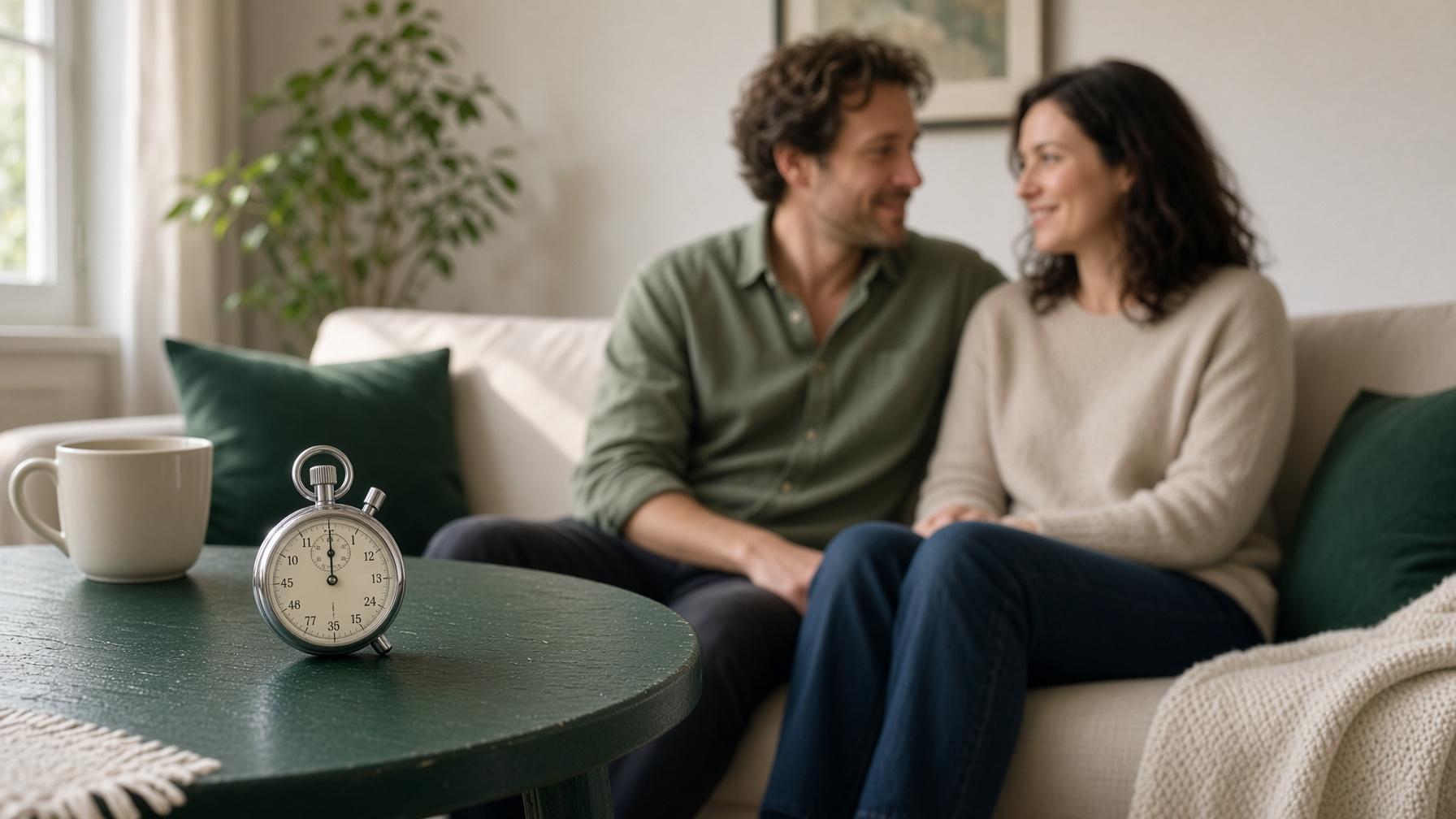
Five minutes can sound short if you are counting from the first kiss. It means something rather different if the clock starts at penetration. That small change of definition explains a good deal of the confusion about how long sex should last.
There is no single duration every couple should aim for. The familiar figure of 5.4 minutes comes from research measuring the interval between vaginal penetration and ejaculation. Kissing, other kinds of touch and anything that happened afterwards sat outside that measurement.
Before comparing yourself with a number, it helps to know what the researchers were counting. A measured duration, someone's preferred duration and the length of a satisfying encounter answer different questions. Online, they can all end up under the same headline.
Where the 5.4-minute figure comes from
In a study published in 2005 in The Journal of Sexual Medicine, Marcel Waldinger and colleagues recruited 500 couples across the Netherlands, the UK, Spain, Turkey and the US. The men were adults in stable heterosexual relationships of at least six months, with regular intercourse. Sexual events and stopwatch timings were recorded over four weeks.
The overall median was 5.4 minutes. That is a useful piece of information about a defined activity in the people studied. To understand it properly, two details matter: where the clock started and what “median” means.
What the stopwatch measured
The researchers used a measure called intravaginal ejaculation latency time, usually shortened to IELT. It runs from the start of vaginal penetration to the start of ejaculation within the vagina. You do not need to remember the acronym; remembering those two endpoints is enough.
This makes comparisons between recorded intervals more consistent. It also gives the statistic a specific scope. Time spent kissing or touching beforehand is outside the interval, as is any sexual activity after ejaculation. Other sexual activities have their own beginnings and endings, so an IELT figure cannot simply stand in for them.
Imagine, purely as an example, a couple spending ten minutes kissing and touching, followed by five minutes of vaginal penetration before ejaculation. Someone describing the whole encounter might say “about fifteen minutes”. Under the study's timing definition, the relevant interval would be five. Both descriptions can be accurate because they count different things.
What a median tells you
A median is the middle value when measurements are put in order. The arithmetic mean, often called the average, is calculated by adding values and dividing by their number. Longer values can pull the mean upwards, which matters here: the researchers described a distribution with a long tail towards longer durations.
Consider five made-up timings of two, three, five, six and twenty minutes. Their median is five minutes; their mean is 7.2 minutes. The long final value raises the mean even though four of the five timings are shorter than it. These are illustrative numbers, but they show why “average” deserves a closer look.
There is another small numerical trap. The study's 5.4 minutes means five minutes and twenty-four seconds, not five minutes and forty seconds. Decimal minutes can look like a clock display when they are copied into a headline. That extra precision still does not turn the result into a personal target.
Why three to seven minutes appears elsewhere
You may also see three to seven minutes described as “adequate” and seven to thirteen as “desirable”. Those figures came from a different kind of investigation.
In a 2008 study by Eric Corty and Jenay Guardiani, American and Canadian sex therapists were asked for their opinions about how long intercourse should last. The researchers summarised the therapists' judgements using interquartile ranges, which describe the middle half of a set of responses. The much-quoted three-to-seven and seven-to-thirteen-minute intervals belonged to those judgements.
The distinction changes how the figures should be read. The 2005 study recorded what happened during a specified activity. The 2008 survey asked professionals what they regarded as adequate or desirable. Professional opinion may help put expectations in perspective, but it is a different source of information from a stopwatch study or a survey of partners' own preferences.
The labels can become unhelpfully personal when they lose that context. Seeing “desirable” beside a range makes it tempting to treat the lower number as a minimum and the upper number as something to achieve. Yet the survey did not establish what your partner wants. Nor did it show that moving an encounter from six minutes to eight would make it more enjoyable.
Does average sex time include foreplay
The 5.4-minute figure excludes foreplay, but other studies have asked about that part of the experience separately.
A separate 2004 study by S. Andrea Miller and E. Sandra Byers asked 152 heterosexual couples to report their actual and desired durations of foreplay and intercourse. It also asked how long they thought their partners wanted those activities to last. These were participants' reports, rather than the stopwatch measurements used in the later Waldinger study.
In that sample, both men and women reported wanting longer foreplay and intercourse than they said they were having. That tells us about those respondents' preferences. It does not supply a universal amount of extra time to add, and it cannot be combined with the other studies to calculate a recommended total.
Separating the stages also makes an ordinary relationship question easier to understand. “I'd like us to spend more time on sex” could mean more time getting interested, more of a particular kind of touch, or a longer period of penetration. Those are different wishes. A statistic about one stage gives little guidance about how to divide the whole encounter.
How much variation did the research find
The 2005 paper reported a range of 0.55 to 44.1 minutes alongside its median. The lower figure converts to 33 seconds. Those values show the breadth of the reported data; they should not be presented as the edges of a medically approved “normal” range.
A study's lowest and highest values describe its observations. They do not automatically tell you what is comfortable, preferred or worth investigating for an individual. Equally, being below the median means being below the middle of that distribution. The word itself carries no judgement about ability.
What would you like more time for?
When you next encounter a claim about the average duration of sex, look for the timing definition first. Then check whether the number came from measured behaviour, remembered experience or an opinion about what would be ideal. That small amount of context can explain why two apparently contradictory figures are both being quoted.
For a personal conversation, a more revealing question is: “When you say you want more time, which part do you mean?” It gets closer to the experience you might want to change. Five additional minutes of an activity you already enjoy and five additional minutes of something uncomfortable have the same numerical length, but very different value.
The Miller and Byers study adds a useful reason to ask. Participants' guesses about their partners' preferred durations were more closely related to their own gender stereotypes than to what their partners actually reported wanting. A widely repeated claim about what men or women like can be a poor substitute for hearing from the person beside you.
Once that preference is clearer, there is something concrete to explore. Perhaps you both want a more leisurely beginning. Perhaps you are curious about a different kind of physical sensation. An encounter can contain familiar pleasures and room for something new, with each choice coming from what interests the people involved.
Choosing a sensory addition that interests you
If what interests you is a different kind of contact, KTRL Portable Smart Patch introduces a rhythmic physical sensation through controlled electrical pulses at the skin's surface. That is a particular experience to explore alongside the touch you already enjoy. It starts with curiosity about a sensation, which is a much clearer reason to choose an accessory than a general feeling that sex ought to contain more of everything.
The format is small: 46 by 40 by 6 mm, weighing 9 g, with its own power supply and no app. If an electronic accessory has always sounded like one more thing to charge and connect, those practical details may be part of its appeal. You can view KTRL Portable Smart Patch and its available packs to see whether the format fits what you have in mind.
The research has given the numbers their proper meaning. The rest of the decision belongs to the encounter you want to have. You may want more time for a kiss, a familiar touch or discovering something you have chosen together. Knowing which part matters gives “a little longer” a meaning that a headline never could.
KTRL is a single-use consumer electronic product for men aged 18–60, for external skin contact only; it is not a medical device or intended to diagnose, treat or prevent medical conditions, and users should follow the printed instructions and suitability restrictions, with no more than 30 minutes of total powered-on time per use.