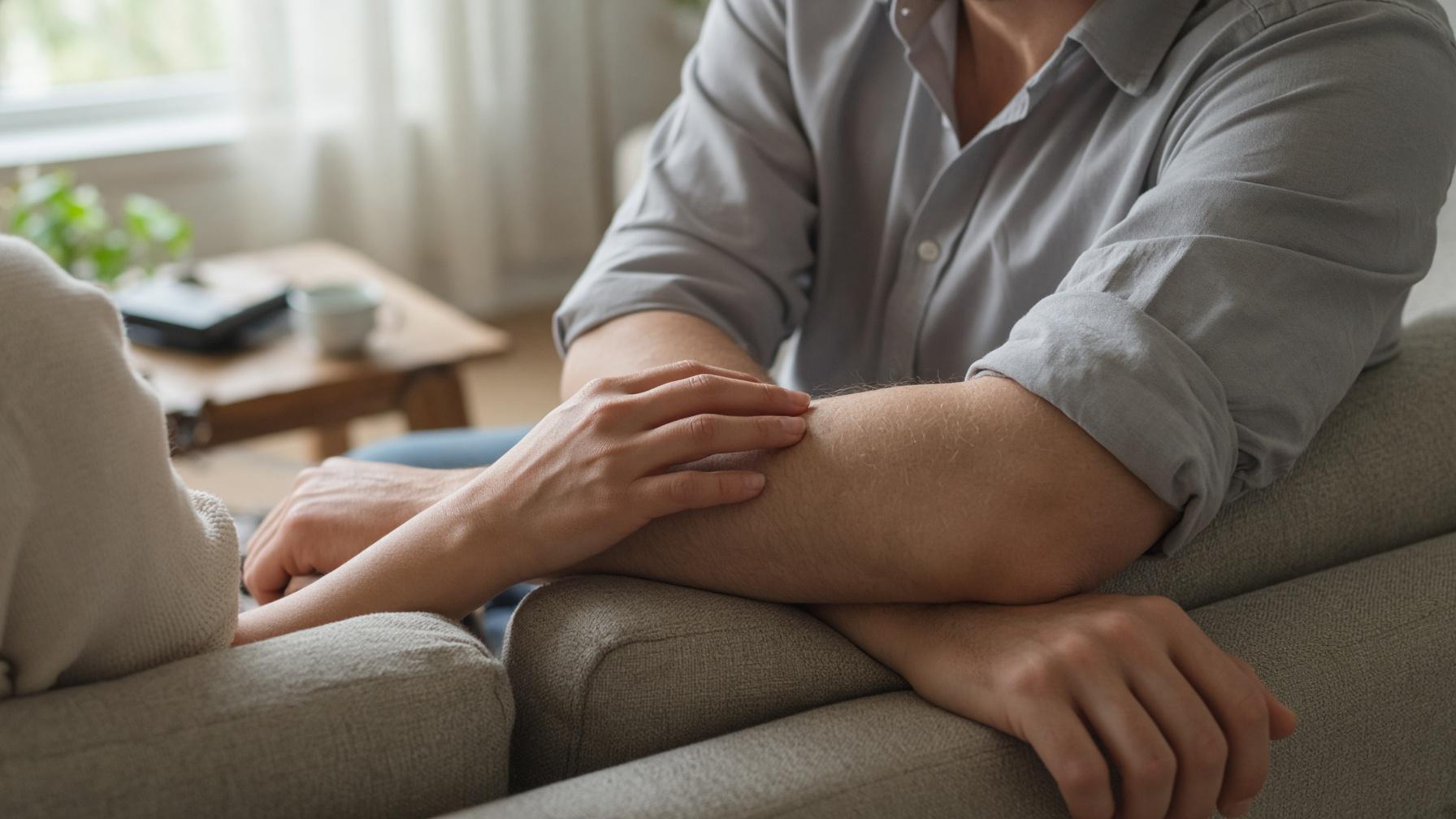
A hand moving across your back can feel unhurried, playful or surprisingly abrupt. Pressure explains some of that difference. Where the hand moves explains more. Then there is the timing: how quickly it travels, whether it keeps going, and how much space falls between one movement and the next.
Pace helps give touch its character. During sex, we often talk about stimulation as though its main setting were intensity, with “more” at one end and “less” at the other. But a light touch delivered in a rapid, broken pattern can feel very different from a light touch that continues smoothly. Its timing has changed even when the pressure remains similar.
Understanding that difference makes it easier to recognise what you actually enjoy. “Too fast”, “too strong” and “too much changing” can describe three distinct experiences. Each points to a different feature of the contact.
Speed and rhythm are different parts of pace
Speed describes how quickly a movement happens. Rhythm describes how events are arranged in time. A movement can be quick, followed by a long pause. Another can be slow, but repeated with almost no gap. Those combinations can give touch quite different qualities.
There is an everyday parallel in speech. Someone may say individual words slowly but leave little room between sentences. Another person may speak briskly and pause often. Calling both conversations “fast” would miss something about how it feels to follow them.
Touch has its own versions of those differences. Movement speed, the duration of contact and the gap before the next movement all contribute to the pattern. Continuity matters too: a sequence of separate contacts has a different shape from movement that stays connected throughout.
A pause belongs to the pattern
Silence is part of a rhythm in music. In touch, an interval can likewise affect how one contact relates to the next. Two touches close together may seem like a pair; widely separated, they may feel like distinct events. The gap helps organise what you perceive.
This gives “pace” a broader meaning than a simple slow-to-fast scale. An encounter can feel hurried because changes keep arriving, even if each individual movement is gentle. It can also feel energetic and coherent because a lively pattern continues in a recognisable way. These descriptions concern the arrangement of contact, rather than a judgement that one pace is better.
Skin responds to how contact moves
There is a physical basis for paying attention to speed. In a human laboratory study of soft brush stroking, Line Löken and colleagues recorded responses from sensory nerve fibres while participants experienced touch at different velocities.
One group of fibres, called C-tactile afferents, responded most strongly at intermediate stroking speeds. Those speeds were also rated as the most pleasant by participants. Other fibres in the study showed a different response pattern. The research connected a property of movement—its speed—with both nerve activity and reported pleasantness.
The setting was a controlled brush-touch experiment. Its relevance is that the timing of movement can matter in its own right, alongside where contact occurs and how firmly it is applied. “Touch is touch” turns out to be a rather incomplete description.
It also explains why describing a sensation only as light or firm can leave out something important. Two contacts can have a similar pressure yet unfold at different speeds. The skin receives a different moving event, and the experience can change with it.
The research is particularly interesting because the relationship was not simply “faster feels better”. The participants' ratings had a pattern across the speeds tested. Pleasantness depended on the kind of touch being studied, which is a good reason to pay attention to the whole experience rather than treating pace as a contest with an obvious winning setting.
A curious illusion shows how much timing can change
Some of the clearest evidence that timing shapes touch comes from a surprisingly playful laboratory phenomenon: the cutaneous rabbit illusion. When taps arrive rapidly at separated places on the skin, people can feel as though the taps are hopping through locations in between—even though those intermediate locations were never touched.
In a paper modelling this and related tactile illusions, Daniel Goldreich and Jonathan Tong examine how the brain may combine uncertain sensory information with expectations about movement. One finding from the research they discuss is that shorter intervals between touches can make the perceived distance between them contract.
The model also allows later touches to influence the perceived location of earlier ones. A sequence can therefore be assembled using information that arrives across a brief interval. Separate moments of contact become part of one perceived event. The illusion offers an unusually vivid example of how the timing of touch can shape what people feel.
The pattern you enjoy may be quite specific
Sexual preferences add another layer. In a US probability survey of 1,055 women aged 18 to 94, Debby Herbenick and colleagues asked about genital touching, pleasure and orgasm. Participants reported varied preferences for location, pressure, shape and pattern of touch.
That survey gives us a useful picture of variety within a defined population. The finding relevant to pace is that pattern belongs among the characteristics people care about. Pleasure involves preferences that can be more detailed than choosing a general category of sexual activity.
Someone might enjoy the continuity of a familiar movement. Someone else may be drawn to clearly separated moments of contact, or to a pattern that changes. Even two people who both describe their preference as “gentle” could be imagining very different rhythms.
The same is true of “intense”. One person might mean firm pressure; another might mean a rapid sequence; a third might mean a feeling of uninterrupted involvement. The word can name the overall impression while leaving its ingredients unclear.
A pause in movement can still contain contact
A hand can stop moving and remain resting against someone's back. There is a pause in movement, while contact continues. If the hand lifts away and returns a moment later, the pause includes an absence of contact. We might call both moments a break, although the skin is receiving different events.
This is one reason a person can enjoy unhurried movement yet prefer a sense of continuity. The attraction may lie in staying connected through the pauses. Another person might enjoy the clearly separated quality of a touch that arrives, ends and returns. Both experiences can happen at a gentle pace.
Similarly, lively movement can take place within continuous contact. Speed alone tells us little about whether that sequence will feel flowing or broken. The changing movement and the presence of contact are two parts of the pattern, and they can vary independently.
When the rhythm comes from an electronic patch
An electronic patch introduces another form of rhythm: a repeating physical sensation delivered at the skin. For someone interested in pulses as a sensory experience, this is an aspect of contact worth exploring alongside movement, pressure and continuity.
KTRL Portable Smart Patch creates rhythmic physical sensation through controlled electrical pulses delivered by skin-surface electrodes. The source of that contact is a self-contained patch with built-in power. Rhythm is therefore a feature of the sensation the product adds, just as continuity or movement can be features of other contact within an encounter.
To explore that format, see KTRL Portable Smart Patch and choose a pack. It offers a concrete example of how rhythm can belong to a sensory product as well as to a moving hand.
One gesture can have several rhythms
Imagine a couple kissing while one person's hand rests on the other's shoulder. The hand makes a small movement, settles, then moves again. The kiss carries on throughout. Contact at the shoulder is continuous, but movement there has its own rhythm; the two do not have to match exactly.
In another moment, the hand lifts as the couple pause to smile at each other, then returns when they kiss again. Now several events have stopped and resumed together. The pressure on the shoulder may be just as light, but the encounter has a more clearly marked interval. A familiar gesture has become part of a different sequence.
One version might feel flowing; the other might have a playful, stop-and-start quality. Neither requires a dramatic change of activity to become a different experience. There is already plenty happening in the timing of these small gestures.
As they lean in again, the hand returns to the shoulder with the same light pressure, joining the start of another kiss.
KTRL is a single-use consumer electronic product for men aged 18–60, for external skin contact only; it is not a medical device or intended to diagnose, treat or prevent medical conditions. Follow the printed instructions and suitability restrictions, with no more than 30 minutes of total powered-on time per use.