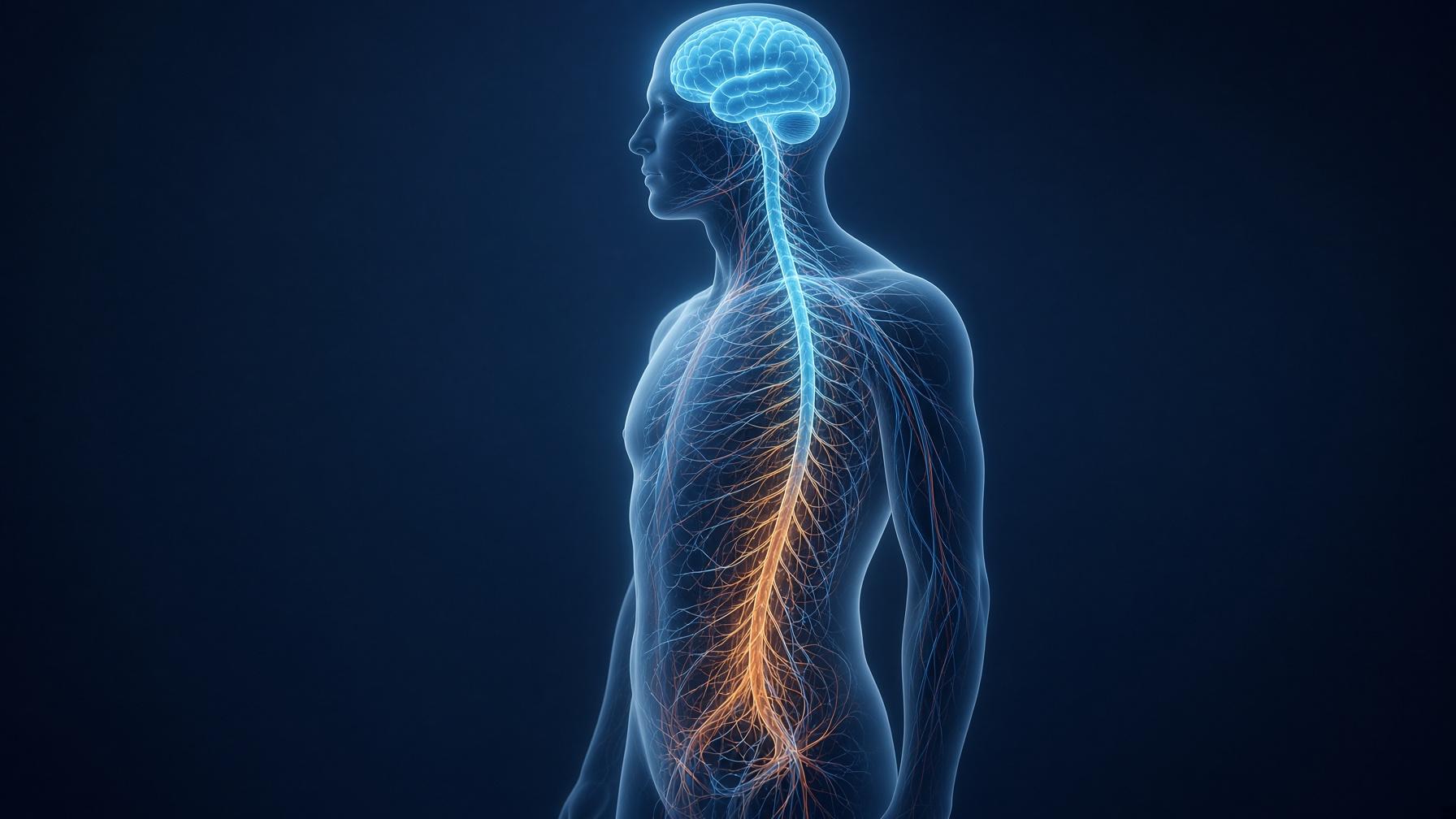
An erection is a coordinated response involving the brain, spinal cord, peripheral nerves and blood vessels. Touch can send sensory information towards the spinal cord and brain; thoughts and other sexual cues can also influence the response. Outgoing nerve signals help change the tone of smooth muscle in erectile tissue, allowing blood to enter and be retained. Feeling a stimulus is one part of this process, rather than a guarantee of an erection.
Understanding the nerve pathways helps explain some familiar experiences: an erection that develops before any touch, a physical response that changes while interest remains, or an erection during sleep. These situations involve overlapping systems, not a single switch that is either working or broken.
In this article
How touch becomes a nerve signal
Sensory nerve endings in the penis respond to physical stimulation. Information from these endings travels along nerve fibres, including those that form the dorsal nerve of the penis, a branch of the pudendal nerve. These pathways carry information towards the lower spinal cord. Some signals then travel upwards to brain regions involved in sensory perception.
The word afferent describes this incoming direction: from the body towards the central nervous system. An efferent pathway carries instructions outwards. The distinction is useful because noticing touch and producing a bodily response are different jobs. Incoming information does not itself determine the final outgoing command.
The review Neural regulation of sexual function in men describes sensory pathways carrying touch, pressure, vibration, temperature and pain. Their involvement in genital sensation does not make every signal sexual or pleasurable. What is felt, how it is interpreted and what response follows need to be considered separately.
For example, clearly noticing contact tells you that a sensation reached awareness. It does not reveal which other nerve pathways are active, how the blood vessels are responding or whether an erection will follow. Sensation is information, not a readout of the whole system.
What the spinal cord and brain contribute
The spinal cord participates in reflex circuits as well as carrying information to and from the brain. Genital touch can contribute to a reflexogenic erection: a response in which sensory input engages spinal pathways and outgoing autonomic signals. Sacral spinal segments, commonly described as S2–S4, are important in this circuitry.
The brain can also influence erection through descending pathways. Sexual thoughts, images, sounds and other cues can contribute to what physiology literature calls a psychogenic erection. In this context, “psychogenic” describes a route involving brain processing. It does not mean imaginary, voluntary or “all in your head”. Both routes produce physical changes.
Dean and Lue's review of the physiology of penile erection describes these routes and their interaction. During an ordinary intimate encounter, touch, attention, anticipation and descending signals can overlap. The categories help explain the anatomy; they are not separate modes that a person deliberately selects.
Nor is there one small “erection centre” in the brain that acts alone. Research describes contributions from several regions involved in motivation, emotion, sensory processing and autonomic control. The hypothalamus is one important part of that network. Some detailed pathway findings come from animal studies, so a simplified diagram should not be mistaken for a complete map of an individual person's experience.
The autonomic nerves that influence firmness
The autonomic nervous system regulates bodily processes that are not usually under direct conscious control. Its parasympathetic and sympathetic pathways both contribute to sexual function. Nerve fibres pass through pelvic networks, and the cavernous nerves carry autonomic input towards erectile tissue.
Parasympathetic pathways are important in promoting the conditions for penile swelling. Sympathetic activity helps maintain smooth-muscle tone in the flaccid state and contributes to the return from erection to flaccidity. These broad roles are described in the review of neural regulation.
It is tempting to translate this into “parasympathetic on, sympathetic off”. Real physiology is more complicated: the pathways interact, and their effects depend on where and when a signal acts. Sympathetic activity also has roles elsewhere in the sexual response. It is not simply an unwanted system to eliminate.
Somatic motor nerves have another task. Through the pudendal nerve, they supply pelvic muscles, including the ischiocavernosus and bulbocavernosus muscles, which can contribute to rigidity. This does not mean that consciously squeezing those muscles is a universal solution to erection difficulties. Describing a muscle's normal role is different from prescribing an exercise programme.
How a nerve signal becomes a change in blood flow
Nerve activity must connect with a local tissue response. Nitric oxide, often abbreviated to NO, is an important chemical messenger in this process. It is produced by relevant nerve endings and by the lining of blood vessels. It activates a pathway involving cyclic guanosine monophosphate, or cGMP, that helps smooth muscle relax.
Relaxation may sound unexpected when the visible result is firmness. The smooth muscle within erectile tissue and its blood supply is not the same as a muscle you deliberately tense. As that smooth muscle relaxes, more blood can enter the corpora cavernosa, the paired erectile bodies of the penis. Their expansion reduces venous outflow, helping retain blood and build pressure. The physiology review explains the nerve, molecular and blood-flow stages together.
A simplified sequence is:
Sensory input and brain activity influence spinal and autonomic pathways.
Outgoing signals contribute to chemical changes in erectile tissue.
Nitric oxide and cGMP signalling support smooth-muscle relaxation.
Blood inflow increases and venous outflow is restricted as the tissue expands.
The combined nerve and vascular response produces swelling and firmness.
This is a teaching outline, not a test or a guaranteed chain reaction. It explains why erection is called a neurovascular event: nerves and circulation both matter.
Why sensation and erection can differ
You can notice touch while the overall response remains less firm than expected. Awareness of sensation answers one question; it does not confirm that every outgoing nerve, chemical and vascular step is producing the same response as on another occasion.
Brain processing also provides context. Attention, worry and competing thoughts can coexist with sexual interest. The NIDDK overview of erectile dysfunction identifies emotional factors alongside conditions affecting blood vessels, nerves and hormones, as well as certain medicines. A physical and an emotional contribution can be present together.
This is why “just relax” is an incomplete explanation. Worry may matter, but an erection change does not prove that anxiety caused it. Equally, feeling aroused does not rule out a physical contributor. There is no need to intensify stimulation to turn a response into proof that everything is functioning normally.
Firmness also does not tell another person what you enjoy or agree to. Those questions need communication. A reflex response and consent are different things.
Why erections also happen during sleep
Erections can occur during sleep, particularly rapid-eye-movement (REM) sleep. The physiology review describes sleep-related changes in central neural activity that accompany these responses. They do not require a conscious decision or deliberate genital touch.
A morning erection may therefore be present when you wake, before you feel interested in sexual activity. This is another example of why a bodily response and a conscious wish do not always line up.
Morning erections are useful information to mention during a medical discussion, but noticing or not noticing one is not a home test that identifies the cause of an erection concern. Do not use a single morning as a verdict on your nerves, circulation or relationship.
When a change deserves medical advice
If difficulty getting or maintaining an erection keeps happening, speak with a GP or qualified healthcare professional. The NHS recommends seeking help for recurring erection problems. Outside the UK, use the appropriate local healthcare service.
Describe when the change began, whether the difficulty is getting an erection or keeping it, and any other changes in sensation, pain, medicines or recent treatment. If you suspect a medicine is involved, discuss it with the prescriber rather than changing treatment yourself.
Knowing the pathways can help you describe what happens more clearly. It cannot locate a nerve injury or select a treatment from your experience alone. An assessment considers the pattern and the person, rather than assuming that one sensation represents the entire erectile response.
Sources
Dean RC, Lue TF. Physiology of Penile Erection and Pathophysiology of Erectile Dysfunction. Urologic Clinics of North America, 2005. Review of neural pathways, haemodynamics and molecular mechanisms.
Azadzoi KM, Yang J, Siroky MB. Neural regulation of sexual function in men. World Journal of Clinical Urology, 2013. Review of central, spinal and peripheral neural control.
NIDDK. Symptoms & Causes of Erectile Dysfunction. General health information on symptoms and possible contributors.
NHS. Erectile dysfunction (impotence). General information and UK advice on seeking care.
Sources checked on 23 October 2026. The physiology reviews explain established mechanisms and include both human and experimental research; they are not trials of a consumer product. This article is general education, not an individual neurological assessment or diagnosis.