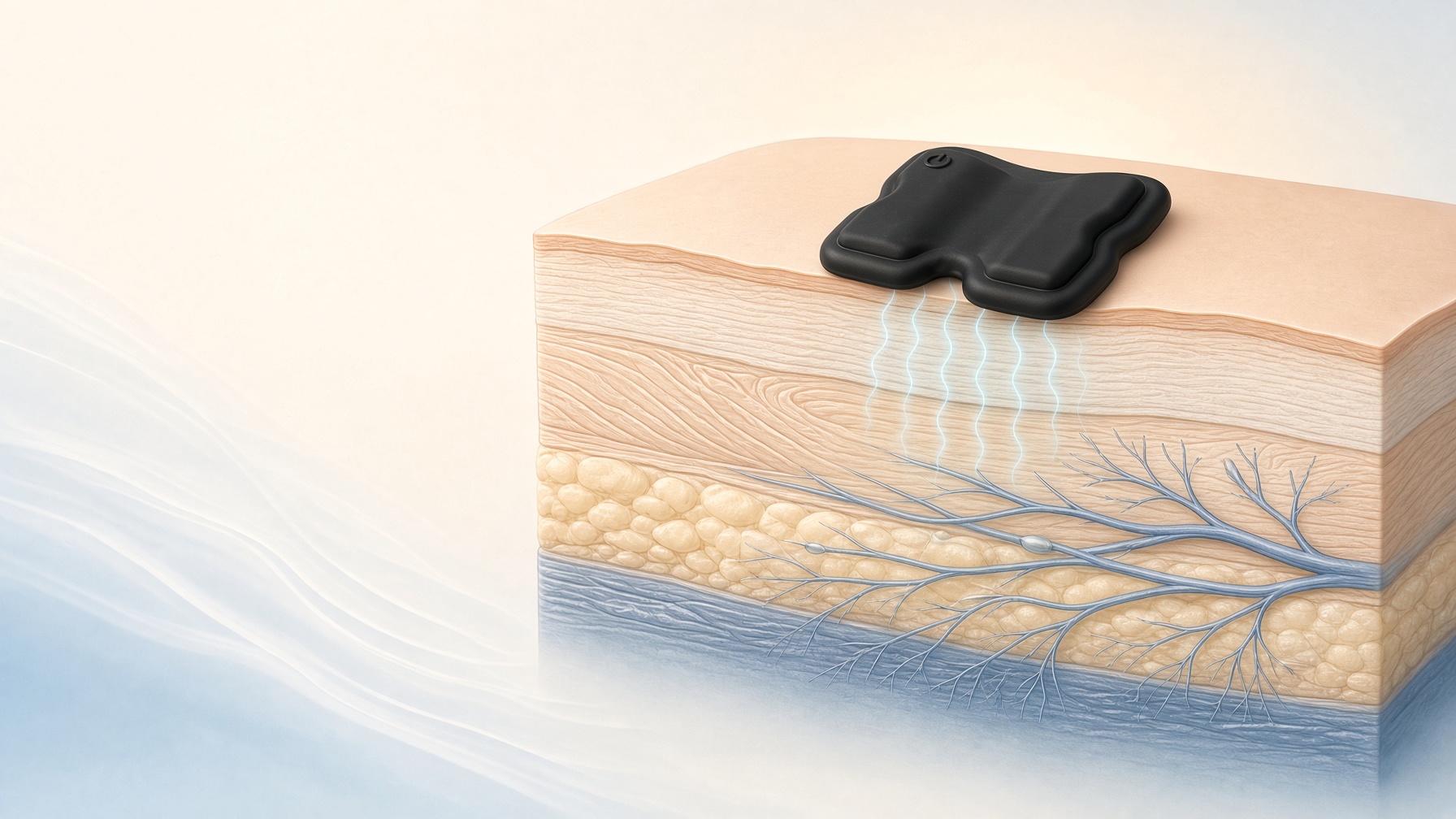
“Transcutaneous” means “through the skin”. In electrical stimulation, it describes a way of delivering electrical current through electrodes placed on the skin's surface. The word tells you about the route of delivery. To understand what a particular device is intended to do, you also need to know its output, where it is used and its stated purpose.
The simplest way to understand the process is to follow the connection: a device produces an electrical signal, an electrode provides contact with the skin, and the applied stimulation can influence nerve activity. The sensation someone notices is one part of that process.
In this article
What is actually passing through the skin?
In the surface-electrode method discussed here, electrical current is applied across intact skin. The electrodes remain outside the body. Describing the method as transcutaneous does not mean that an electrode is inserted under the skin.
One familiar example is transcutaneous electrical nerve stimulation, or TENS. In his review of TENS principles and practice, researcher Mark I Johnson describes pulsed currents delivered across the intact skin surface through conducting electrodes to stimulate peripheral nerves. That example makes the route clear: surface contact allows electrical stimulation to be delivered without an implanted electrode.
A patch shape alone tells you much less. It does not establish whether a product delivers electrical stimulation, how that stimulation is produced or what it is intended to achieve. Read the description of the mechanism rather than relying on its appearance.
What do the electrodes do?
An electrode is the electrical contact between the stimulation system and the body. In a surface system, its skin-facing area provides the point of contact through which current is applied. The device's electronics generate the stimulation; the electrode is part of how that output reaches the person.
The NHS explanation of a conventional TENS machine describes a battery-powered unit connected by wires to sticky pads placed on the skin. That is a specific arrangement, not a requirement that every surface-stimulation product must have visible wires.
Three details therefore deserve separate attention: the source of the signal, the contact with the skin and the permitted placement. A photograph may show the outside of a device while leaving the last two unclear. The instructions should explain the intended contact area and use; the shape of a pad is not a placement guide.
Electrode position also belongs to the description of a studied intervention. Two devices that both touch the skin should not be assumed to stimulate the same structures simply because their contact pads look similar.
How can electrical stimulation create a sensation?
Peripheral nerves carry signals between the body and the central nervous system. Applied electrical pulses can generate activity in nerve fibres. When sensory pathways are involved, that activity can be experienced as a bodily sensation.
Johnson's physiological explanation of TENS describes how the characteristics of the applied current influence which nerve fibres are recruited. In conventional sensory TENS, the intended experience is a non-painful tingling sensation. The NHS also describes tingling and makes clear that it should not be painful.
That example does not predict how every electrical product will feel. The stimulation pattern, output and location matter. A person may describe a repeating pulse or a more continuous tingle, but those words alone cannot identify the complete electrical settings or the exact tissue being stimulated.
There is a further distinction between a sensory experience and a muscle response. The FDA's explanation of electrical muscle stimulators describes devices that use electricity to produce muscle contractions. Feeling a tingle does not, by itself, demonstrate that such a contraction is occurring.
Why can it feel rhythmic?
Many surface-stimulation systems deliver pulses: brief changes in electrical output arranged over time. A pulse pattern provides a reason that stimulation can feel repetitive rather than like an unchanging pressure against the skin.
The vocabulary describes different parts of the signal:
Amplitude describes the magnitude of the current pulse.
Pulse duration describes how long an individual pulse lasts.
Frequency describes how often the pulses repeat.
Pattern describes how pulses are arranged, for example continuously or in bursts.
These distinctions appear in the review's discussion of stimulation characteristics. They explain the terminology, not which settings a reader should choose. A product's “level 2” is also not a universal unit that can be compared directly with another device's “level 2”.
It helps to separate the rhythm from the strength. Two patterns can repeat at different rates without the faster one necessarily being more suitable or more effective. Likewise, a more noticeable sensation is not automatically a better result. The relevant outcome depends on the purpose of the particular intervention.
Why the route does not tell you the purpose
“Through the skin” answers how stimulation is delivered. It does not, on its own, answer which nerves are targeted, whether a muscle contraction is intended or what change should be measured.
For example, the NHS describes TENS in a pain-relief context. Electrical muscle stimulation has other intended responses and applications. Sharing a surface-electrode route does not make those purposes interchangeable.
The same distinction matters when reading research. A study of pain relief asks whether pain changed under particular conditions. It cannot establish a different product's effect on erection, ejaculation timing or any other outcome merely because that product also uses electricity.
Instead, look for a match between the device, the way it was used, the people studied and the outcome reported. Sensation can be an observation during use; a claim about a lasting change needs evidence that actually measured that change over time.
How to read a product description
Start with three questions: what does the device deliver, where is it intended to be used, and what is its stated purpose? A useful description keeps those answers distinct.
“Produces a rhythmic sensation” describes an experience. “Intended to produce muscle contractions” describes a different response. “Shown to improve a particular clinical outcome” is an evidence claim that needs an appropriate study. None can be substituted for another just because the word “transcutaneous” appears nearby.
If a technical detail is missing, leave it unknown. You cannot work out a complete stimulation protocol from the product's size, its shape or how strong it feels. Nor should an unfamiliar term be treated as a reason to copy the settings or placement shown for another device.
What skin contact means for use
A surface method still requires attention to the skin, the contact materials and the device's restrictions. For example, NHS TENS guidance says to avoid irritated, broken, infected or numb skin and to stop if the skin becomes itchy, irritated or red. These are instructions for TENS, not a complete suitability checklist for every electrical product.
Follow the instructions for the exact device and body area. If the intended use or placement is unclear, clarify it before use. Health conditions, implanted electronic devices or uncertainty about suitability are reasons to seek qualified advice and check all contraindications. Feeling a signal is not a reason to continue through discomfort.
The useful meaning of “transcutaneous” is therefore quite specific: it describes a route across the skin. The next questions—what is delivered, where it acts and what it achieves—come from the individual device, its instructions and the evidence for its intended use.
Sources
Johnson MI. Resolving Long-Standing Uncertainty about the Clinical Efficacy of Transcutaneous Electrical Nerve Stimulation (TENS) to Relieve Pain: A Comprehensive Review of Factors Influencing Outcome. Medicina, 2021;57(4):378. Sections on principles, physiological mechanisms and stimulation characteristics.
NHS. TENS (transcutaneous electrical nerve stimulation). Reviewed 14 February 2025. Explanation of surface electrodes, sensation, intended use and precautions.
US Food and Drug Administration. Electronic Muscle Stimulators. Content dated 17 December 2017. Background on electrically induced muscle contractions and device-specific uses.
Sources checked on 23 October 2026. This article explains terminology and basic mechanisms. It does not provide a stimulation protocol or establish the effectiveness of a particular consumer product.