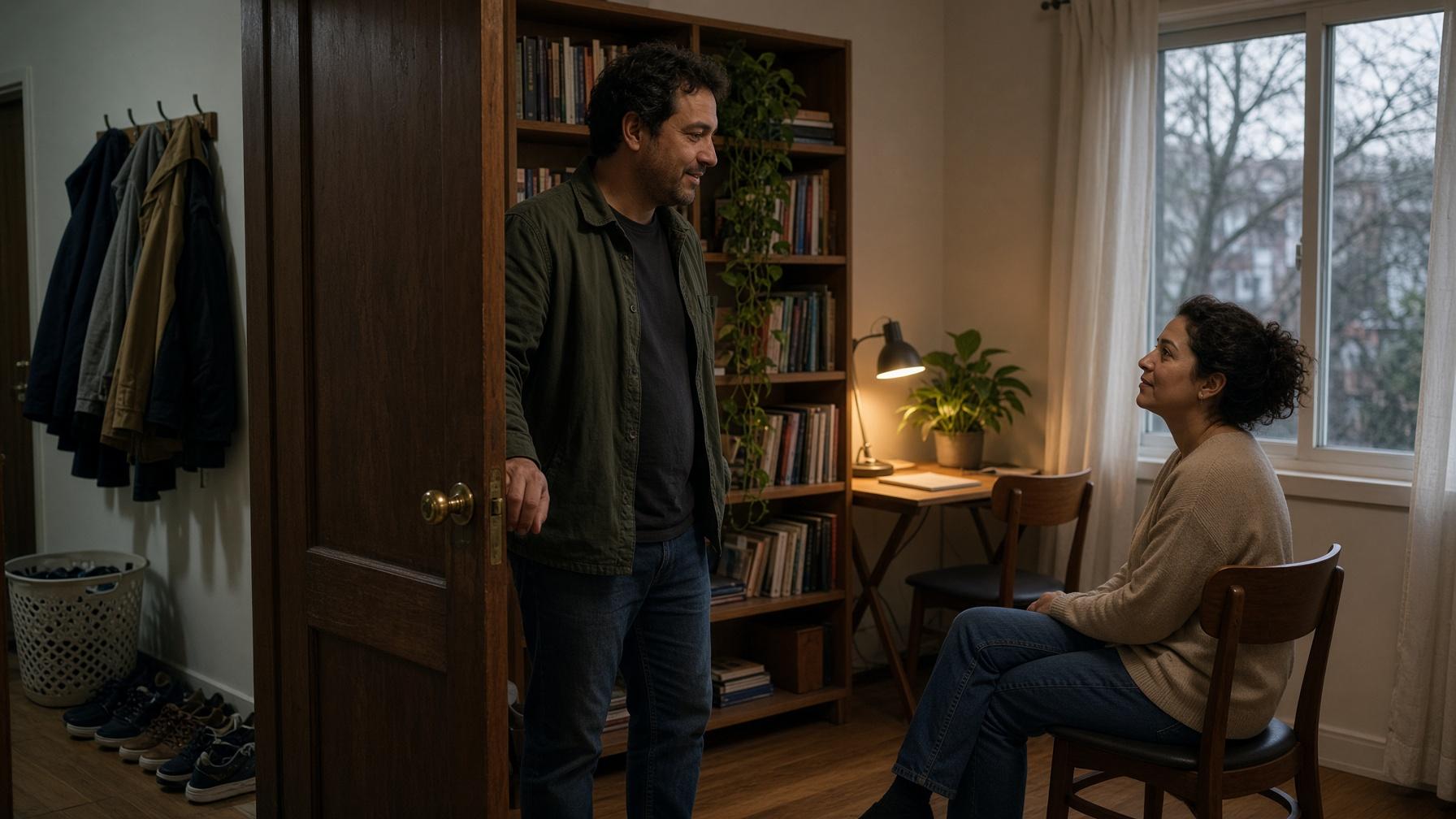
You may love the people you live with and still wish, occasionally, that nobody could knock on the door. Sharing a home with children, relatives or housemates can make private time scarce. The difficulty is not necessarily a lack of attraction. Sometimes it is the entirely practical problem of never knowing when you will be interrupted.
Making room for intimacy starts by identifying the privacy you are missing. Is it a closed space, freedom from being overheard, time without care responsibilities, or the ability to leave personal belongings somewhere secure? Each concern calls for a different arrangement. A blanket instruction to “be more spontaneous” does not create an extra room.
Privacy has more than one layer
Physical privacy concerns access: who can enter, whether a door closes and whether there is a predictable period alone. Acoustic privacy concerns what others might hear. Informational privacy concerns messages, purchases or personal items. Emotional privacy is the freedom to share something without expecting relatives or housemates to comment on it later.
These layers can overlap without being interchangeable. A bedroom door may close while sound still travels. A couple may have an empty house but remain responsible for responding immediately to a dependent person's needs. A hidden purchase does not create time alone, and time alone does not make an unwanted encounter acceptable.
The World Health Organization's sexual health framework includes respect, safety and the right to privacy within a broader understanding of sexual wellbeing. That does not supply a universal household solution. It does establish that privacy is a legitimate need, rather than a frivolous request that adults should feel embarrassed to mention.
Name the interruption you are trying to prevent
“We never have privacy” can mean “someone walks in”, “we are afraid of being heard” or “I am always listening for a child who needs me”. Ask which situation is actually getting in the way. You may find that one person feels comfortable while the other remains alert to a risk the first has not noticed.
Respect that difference. It is not useful to insist that someone should be able to relax because you think the house is quiet enough. Their willingness matters more than proving that an interruption is unlikely. The goal is a shared arrangement, not persuading the more cautious partner to tolerate exposure.
Household boundaries do not need intimate explanations
With adult housemates, a general agreement about knocking and waiting for an answer can protect everyone. So can respecting closed doors, not borrowing devices without permission and keeping private possessions private. Nobody needs details about your sex life to understand a reasonable boundary around a room.
In a multigenerational home, the conversation may be more sensitive. A request for an uninterrupted evening or a short period alone can be framed as ordinary couple time. It is possible to be considerate of family expectations without treating your relationship as something you must explain in public.
Children need arrangements appropriate to their age and care needs. Personal time must not depend on leaving them without suitable supervision or making them responsible for protecting adult intimacy. If another trusted adult can take over care, that handover should be clear. If nobody can, the plan has to fit the responsibility you still have.
Similarly, caring for an older or disabled relative may require reliable cover rather than merely closing a door. A person who remains responsible for responding is not necessarily mentally off duty. Recognising that fact can prevent a partner's watchfulness from being mistaken for disinterest.
Build a realistic opportunity, not a secret operation
Look for an overlap that already exists in the household routine. Perhaps adult housemates regularly go out, or both partners have a free afternoon. The useful feature is predictability. You do not need an elaborate plan that depends on several people behaving exactly as expected.
Agree on what you will do if the opportunity changes. If someone comes home early or a child needs attention, the encounter can stop. Treating the window as your only chance for weeks can create pressure to continue when one person is uncomfortable. Scarcity is a practical problem, not a reason to override a boundary.
Affection can also exist outside private sexual time. A kind message, a shared walk or sitting together may help a relationship feel present in a busy household. These gestures should not become coded promises that sex will follow. Their value does not depend on turning into something else later.
If you are considering time away from home, include cost, travel and care arrangements in the decision. A hotel or short break is one possible choice, not a requirement for a healthy relationship. Advice that assumes spare money or available childcare can miss the circumstances creating the difficulty in the first place.
Choose belongings that fit the space you actually have
Once private time is genuinely available, the amount of equipment involved may matter. Some people prefer fewer accessories, less storage space or an option that does not require a phone. These are practical preferences that can be discussed separately from what kind of sensation interests you.
KTRL Portable Smart Patch is a compact, self-contained skin-contact patch measuring 46 × 40 × 6 mm and weighing 9 g. It uses controlled electrical pulses through surface electrodes to create a rhythmic physical sensation. Its built-in power means there is no separate controller, app or charging equipment to include in your plans.
For someone comparing formats in a small home, those documented details offer a concrete basis for a choice: size, accompanying equipment and the kind of sensation provided. You can view the KTRL Portable Smart Patch together and decide whether that format suits your interests and available space. A compact item may appeal when you prefer to keep equipment together in a small personal space instead of setting aside storage for several separate accessories.
If purchases are part of your privacy concern, check the seller’s actual packaging and delivery options before ordering. Private storage, delivery arrangements and time alone are separate decisions. It is better to know who receives household parcels and where adult belongings can be kept securely than to assume that a small product automatically provides discretion at every stage.
Talk about the burden of arranging privacy
Private time can become another invisible job. One person may always monitor the household schedule, arrange care, prepare the room and worry about being interrupted. The other experiences a convenient opportunity without seeing the planning behind it. Sharing that work can matter as much as finding the time itself.
A meta-analysis of sexual communication and satisfaction (Journal of Family Psychology) found that communication quality was positively associated with sexual and relationship satisfaction. It did not test a particular household privacy plan. The relevant point is that a useful conversation concerns both people's experience, rather than simply counting how often intimacy happens.
Discuss what is sustainable. An arrangement that works once but leaves one person exhausted may not be a good routine. Ask whether both of you can request time, decline contact and contribute to preparation. Keep ordinary household privacy rules consistent, rather than introducing them only when you want sex.
Sometimes the available space remains genuinely limited. You do not have to pretend that a few communication tips will solve housing costs, overcrowding or demanding care responsibilities. You can still identify the smallest workable improvement: a reliable handover, a respected closed door or a period when neither person is expected to be available to everyone else.
Privacy is most useful when it allows choice. The aim is not to make a full house disappear, but to create an arrangement in which both people can be present, comfortable and free to decide what kind of closeness they want.
KTRL is a single-use consumer electronic product for men aged 18–60, for external skin contact only; it is not a medical device or intended to diagnose, treat or prevent medical conditions. Follow the printed instructions and suitability restrictions, with no more than 30 minutes of total powered-on time per use. Keep adult products securely away from children and follow their storage information.