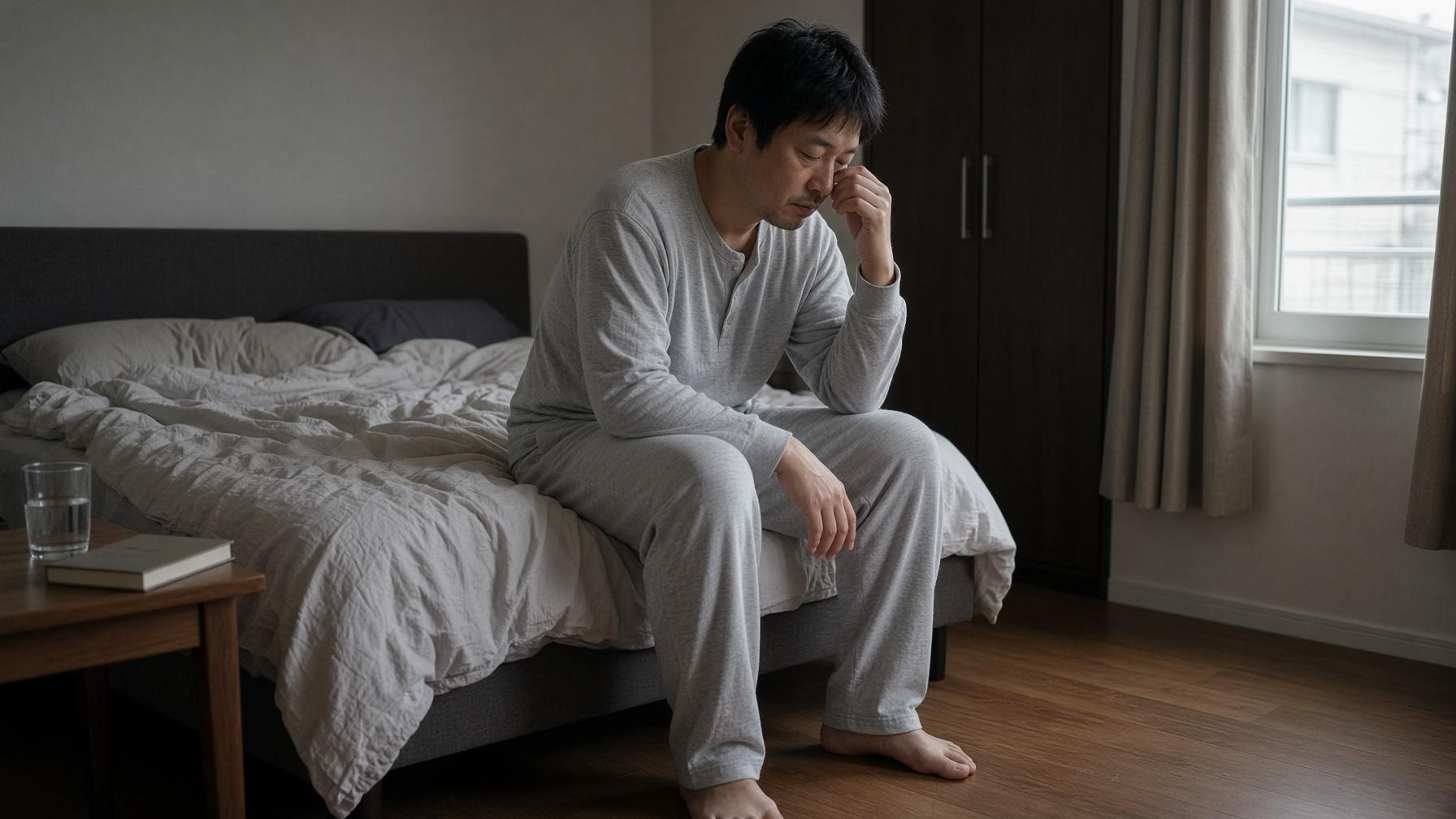
By bedtime you have finally finished everything, except being tired. Your partner reaches for you and the response you notice first is a wish to sleep. That can feel confusing if attraction is still there. Wanting someone and having enough energy to engage with that desire are not always the same thing.
Poor sleep can influence the conditions in which sexual interest appears: mood, concentration, energy and the time available for closeness. Research also finds associations between sleep and aspects of sexual response. But there is no simple conversion in which an extra hour of sleep guarantees a particular increase in libido, and one exhausted evening does not diagnose a sexual problem.
Start by separating desire, tiredness and opportunity
“We are having less sex” describes behaviour. It does not yet explain why. You might still want sex but keep falling asleep before there is private time. You might have time together yet feel too depleted to welcome contact. Or your interest may have changed more generally, including when you are rested.
These differences matter because the next step changes with the explanation. A later bedtime will not solve a lack of energy. A romantic invitation cannot remove repeated night waking. And a persistent loss of desire should not automatically be dismissed as tiredness without considering health, medication, mood and the relationship.
Ask what happens on relatively rested days, without treating those days as a test. Is interest more accessible? Does affectionate contact feel easier? Is there still a concern? A pattern across ordinary life gives more useful information than deciding what a single night means about your attraction.
What the sleep research actually measured
A pilot study of sleep and female sexual response (The Journal of Sexual Medicine) followed 171 women recruited from a US university setting. They completed daily reports for two weeks. Longer sleep was associated with greater sexual desire the next day and higher odds of partnered sexual activity.
The findings were more complicated for genital arousal. Longer sleep on a particular night predicted poorer next-day genital arousal in one analysis, while women who slept longer on average reported better genital arousal than women with shorter average sleep. Different outcomes and different levels of comparison did not all move in the same direction.
That detail matters. A headline claiming that more sleep simply means better sex would flatten the study into a promise it did not test. This was a diary study, not an experiment assigning people a sleep treatment, and the sample does not represent every age or gender. Its useful contribution is evidence that sleep deserves attention in understanding sexual experience.
An association is not a bedtime prescription
People who sleep differently may also differ in stress, daily routines, health or opportunities for partnered contact. Researchers can account for some variables, but a study cannot capture every part of life. The finding does not mean that a couple should schedule a precise amount of extra sleep to produce sex the next day.
It also does not turn a partner's rest into an investment that must be repaid with desire. Someone can sleep well and still not want sex. Rest has value for health and daily functioning independently of whether it changes sexual activity.
Fatigue can alter how an invitation lands
An affectionate gesture at the end of a long day may feel like comfort to one person and another demand to the other. The difference can be especially sharp when one person has been handling repeated night-time care or working irregular shifts. Their available energy may not match the household's idea of a convenient bedtime.
Sleep loss can also make a conversation harder to navigate. The US National Heart, Lung, and Blood Institute explains that insomnia can involve daytime sleepiness, trouble focusing and feeling easily annoyed. Those experiences can affect how patient or attentive someone feels without providing a complete explanation for a disagreement.
If an invitation is declined, try not to leap from “too tired tonight” to “no longer attracted to me”. Equally, the tired person can help by describing the situation clearly when they can. “I want closeness, but I need sleep now” gives more information than silence. There is no need to offer contact you do not want in order to make that boundary acceptable.
Move the opportunity before sacrificing more sleep
If intimacy always competes with the final minutes of the day, consider whether another period is possible. An unhurried morning, an afternoon when both are free or a shorter interval before exhaustion may fit better. These are possibilities to discuss, not rules about the best time for sex.
For some couples, the important change is not the clock but the workload. If one person handles every night waking, arranging an earlier date does not address the missing rest. Shared care, practical support or a different division of tasks may be more relevant than a new romantic routine.
Shift work creates another challenge: your rested hours may not overlap. A useful plan respects both people's sleep needs rather than repeatedly asking the same person to stay awake. When no good overlap exists, acknowledge the constraint. It is a scheduling difficulty, not necessarily a relationship verdict.
Try protecting nonsexual affection from the pressure to continue. A brief cuddle or conversation can remain exactly that if both want it. Otherwise, someone who needs sleep may begin avoiding all contact because it seems to invite a negotiation about sex.
There may also be a difference between time in bed and time asleep. A person who lies down early but wakes repeatedly has not necessarily obtained more restorative rest than a partner with a shorter, uninterrupted night. Avoid comparing only the clock times or assuming that whoever stayed in bed longer must have more energy. Ask about the experience of the night. Acknowledging disrupted sleep can make a practical request for help easier to understand, particularly when the disruption involves care responsibilities that only one person usually handles.
Improve sleep for its own sake
The NHS recommends consistent waking times, a comfortable sleeping environment and a period of winding down before bed for people dealing with insomnia. It also advises seeking help when sleep problems last for months, changes to habits have not helped or daily life is becoming difficult to manage.
Choose a realistic first adjustment rather than attempting an immaculate bedtime routine. Perhaps work messages can stop earlier, caffeine can be reviewed, or light and noise can be reduced. Some causes need professional assessment; poor sleep is not always a matter of discipline.
If a partner notices loud snoring, breathing interruptions or marked daytime sleepiness, mention those symptoms to a clinician. They are relevant to evaluating sleep and should not be explained away as ordinary ageing or a busy week. Do not use alcohol as a sleep solution or stop prescribed medication without advice.
Keep any notes simple if you want to discuss a pattern with a professional: approximate sleep times, waking, daytime fatigue and when the sexual concern began. You do not need a minute-by-minute log of intimacy. The point is to describe your experience, not monitor your body for failure.
Know when the question is bigger than one bad night
Persistent changes in desire, recurrent sexual difficulties, pain or significant distress deserve a broader conversation with a GP or sexual health professional. Sleep may be one part of the picture alongside medication, mood, physical health and relationship factors. An assessment can help separate them without assuming a single cause.
For a tired couple, the most useful immediate question may be “Where can rest and closeness both fit?” rather than “Why are we failing to want sex at bedtime?” Protecting sleep does not push intimacy out of the relationship. It recognises that the people sharing it have bodies and lives that need recovery too.