Premature ejaculation (PE) is a recurring ejaculation-timing concern involving ejaculation sooner than wanted, difficulty delaying it, and negative effects such as distress, frustration, avoidance, or relationship strain. Definitions vary, so one stopwatch result—or one early ejaculation—does not diagnose PE.
The short answer: PE is not just “a small number of minutes”
Five features matter together
Most professional definitions consider several features together:
1. Timing: ejaculation occurs very quickly or much sooner than a person's established pattern.
2. Control: the person feels little ability to delay ejaculation.
3. Pattern: the experience is persistent or happens in most relevant encounters, not just once.
4. Impact: it causes distress, frustration, avoidance, reduced satisfaction, or interpersonal difficulty.
5. Context: lifelong and acquired patterns are different, and other sexual or health concerns may be relevant.
The ISSM quick reference guide summarizes the same core structure: latency, perceived control, and negative personal consequences.
Why definitions do not all use the same clock
You may see one minute, two minutes, three minutes, or phrases such as “a very short duration” in different sources. Those differences reflect distinct guidelines, subtypes, study methods, and sexual contexts.
For example, the ISSM guide describes lifelong PE as ejaculation before or within about one minute of vaginal penetration from the first sexual experiences. For acquired PE, it describes a clinically significant reduction from a person's previous pattern, often to about three minutes or less—together with low control and negative consequences. The EAU guideline likewise tells clinicians to assess self-estimated latency, perceived control, distress, and interpersonal difficulty rather than relying on latency alone.
Why thresholds are not a home pass/fail test
These thresholds are clinical framework components, not a home pass/fail test. They were also developed largely around penetrative partnered sex and may not map neatly onto every person, partner configuration, or sexual activity.
The more useful question is not “Did I beat a number?” It is “Is there a recurring pattern of timing I do not want, low ability to delay, and meaningful distress?”
One early ejaculation is not the same as PE
Timing varies. A particularly exciting encounter, a new partner, a long period without sexual activity, anxiety, or unfamiliar stimulation can change what happens on one occasion. The ISSM guide even distinguishes irregular, inconsistent early timing as a natural variation rather than a sexual dysfunction.
After one non-urgent event:
· do not apologize as if you committed an offense;
· do not promise a specific duration next time;
· do not force an immediate “retest” to prove yourself;
· note whether the event was unusual for you; and
· talk with your partner before embarrassment becomes distance.
Read One Difficult Night Does Not Define Your Sexual Health if the event was isolated.
Lifelong and acquired patterns are different
Lifelong PE refers to a pattern present from a person's earliest sexual experiences. Acquired PE begins after a period when ejaculation timing felt satisfactory or controllable.
The distinction matters because the history is different. With an acquired change, a clinician may pay particular attention to when the shift began, other changes in erection or desire, medicines, physical symptoms, stress, and relationship context. With a lifelong pattern, the timeline and consistency from early experiences are central.
Neither label is a moral judgment. They are ways to organize a history.
PE and erectile dysfunction are not the same concern
PE is mainly about ejaculation timing, control, and distress. ED is about getting or keeping an erection firm enough for desired sexual activity. They can occur separately or together.
Sometimes a person worries about losing an erection and rushes toward ejaculation. Sometimes ejaculating leads naturally into the resolution phase, and the loss of erection afterward gets misread as ED. Sometimes a genuine recurring erection concern exists alongside a timing concern.
Use the five-part sexual-response map to describe which event happened first rather than assuming one label explains everything.
Distress matters—but shame should not be used as proof
Professional definitions include distress or negative consequences because a pattern becomes clinically relevant partly through its impact. That does not mean you must feel devastated to deserve help. It also does not mean shame proves that you have PE.
Your distress may come from:
· feeling little choice about timing;
· avoiding sex because you expect criticism;
· believing a partner's pleasure depends on penetration lasting a particular number of minutes;
· comparing yourself with entertainment, jokes, or exaggerated stories; or
· repeated arguments in which timing becomes a symbol for attraction or care.
Clarify what is distressing: the body pattern itself, the lack of control, the relationship response, the expectation, or a combination. That gives you more than one route toward support.
A low-blame conversation with a partner
A partner may feel disappointed; a man may hear that disappointment as “you are not enough.” He may then avoid closeness, while the partner interprets the avoidance as rejection. This is one way a sexual concern can grow into tension at home without either person intending it.
What you can say
Try:
“I noticed I finished sooner than I wanted, and I felt embarrassed. I do not want us to make penetration time the only measure of the experience. Can we talk about what felt good, what felt pressured, and what we both want next time?”
What a partner can say
The partner can respond:
“I want us to solve this together, not grade you. Let us talk about the whole experience and decide whether we want information or professional support.”
When to seek professional support
When a pattern deserves assessment
Consider a qualified healthcare professional when the pattern:
· happens consistently or across most relevant encounters;
· feels difficult to delay;
· represents a clear change from your previous baseline;
· causes ongoing distress, avoidance, or relationship strain;
· occurs with erection difficulty, pain, urinary symptoms, or another new concern; or
· may overlap with a medicine or health change.
What assessment may consider
Assessment generally starts with medical and sexual history; clinicians may also consider the partner and relationship context. The EAU recommends evaluating latency, control, distress, and interpersonal difficulty as part of PE assessment.
Use When Does a Sexual Concern Deserve Professional Support? to plan that next step.
Where a rhythmic sensory cue may fit
When a sensory cue may match the goal
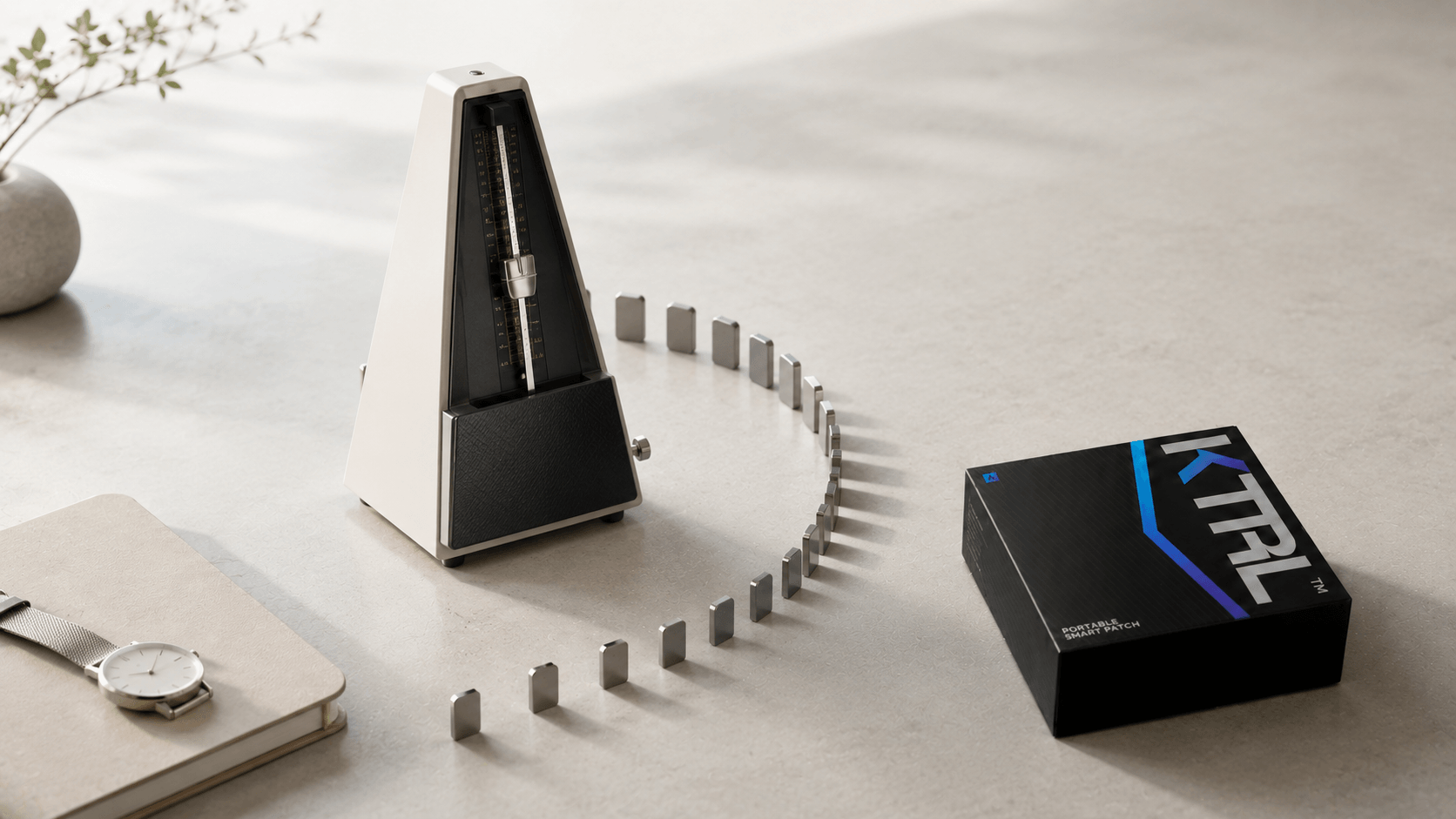
If your personal goal is to bring more structure and timing awareness to a consensual private routine, KTRL offers a compact, self-contained, single-use TES patch designed to add a rhythmic physical sensation through external skin contact. It can be considered as an optional cue for deliberate pacing and sensory exploration, without adding an app, charging cable, separate controller, or separately applied topical delay formula. Review the current KTRL product details and decide whether that format matches your goal.
When education is the better next step
For readers who are not ready to choose a routine, the better next step is education. Join the KTRL email list for practical notes on timing awareness, confidence, and partner communication.
KTRL Portable Smart Patch is a consumer lifestyle product for adult external use; it is not intended to diagnose or treat a medical condition, individual experiences vary, and persistent or distressing concerns should be discussed with a qualified healthcare professional.